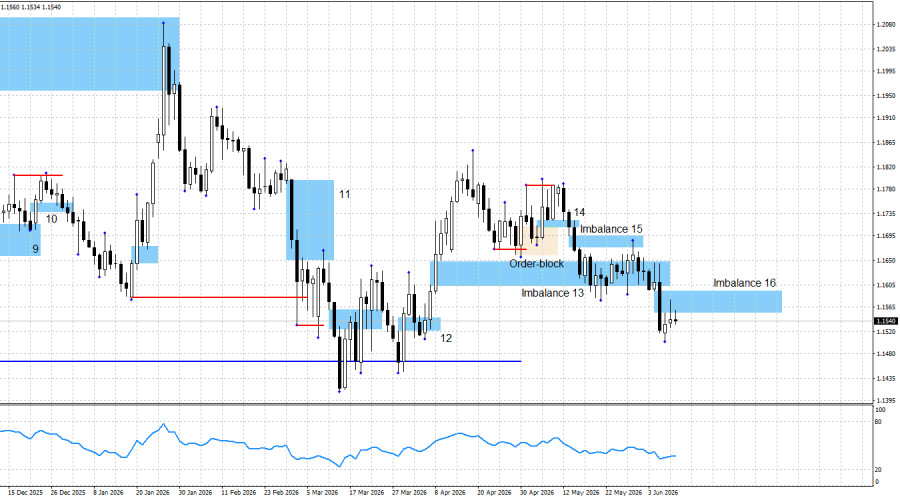
EUR/USD continues to drift gradually lower. This week, bulls have already made two attempts to halt the bearish advance, but both ended unsuccessfully. Although the Nonfarm Payrolls report does not belong to the category of geopolitical events, it triggered a sharp decline in the pair last Friday, resulting in the formation of bearish imbalance 16. At present, this imbalance serves not only as an area of interest for bears but also as a resistance zone for bulls.
On Monday, bulls failed to break through this zone, and they were equally unsuccessful on Tuesday. As for Wednesday, there was little chance of such an attempt, as active military operations resumed in the Middle East. Iran responded to U.S. strikes on its military facilities, which Washington had carried out in retaliation for the destruction of a U.S. military helicopter. Therefore, although today's bearish pressure remains relatively weak and cautious, the bears currently appear to hold the more favorable position. The technical picture supports further weakness in the euro, while the renewed escalation of the geopolitical conflict in the Middle East continues to support the U.S. dollar.
Tomorrow, the European Central Bank is highly likely to raise interest rates, yet the market has shown little reaction to this event despite having had ample opportunity to do so since the beginning of the week. It should be recalled that the ECB's intention to tighten monetary policy has been known for several days.
The objective reality is that the conflict in the Middle East shows no signs of ending, while Tehran and Washington remain unable to reach an agreement acceptable to both sides. Iran and the United States resumed exchanging missile strikes this week, and Donald Trump once again threatened Iran with complete military destruction. However, such developments are unlikely to surprise anyone anymore, as both sides have repeatedly carried out strikes while appearing more concerned about avoiding any appearance of weakness than about preserving the negotiation process. As a result, the U.S. dollar remains the preferred currency for traders due to geopolitical considerations.
The pair's movement and trader sentiment will continue to depend primarily on geopolitical developments. If Tehran and Washington ultimately sign a memorandum of understanding, extend the ceasefire, and make progress on the nuclear issue, bears may be forced to retreat, allowing the euro and pound to resume their upward movement. However, negotiations may once again be suspended in the near future.
Under current conditions, traders may continue to focus on bearish patterns. A new sell signal could emerge from bearish imbalance 16 as early as today. Nevertheless, if an agreement between Iran and the United States is eventually reached, the euro may resume its upward movement despite bearish technical patterns. Such a scenario appears unlikely in the near term, which leaves bears with considerable freedom to continue applying pressure. Market sentiment continues to shift from one side to the other, forcing traders to adjust their strategies constantly.
I would once again emphasize that the entire appreciation of the U.S. dollar during January–March was driven solely by geopolitical developments. As soon as the United States and Iran agreed to a ceasefire, bears immediately retreated, and bulls dominated trading activity for more than a month. At present, the likelihood of a comprehensive agreement is declining once again, and the market remains highly skeptical of any reports suggesting a rapid end to the conflict or a breakthrough in negotiations between Iran and the United States. Consequently, geopolitical factors continue to exert underlying pressure on EUR/USD.
The economic calendar had virtually no impact on trader sentiment on Wednesday. Only one report was released during the day that could have attracted market attention. U.S. inflation accelerated to 4.2% in May, matching market expectations. As a result, traders found little reason to react.
Bulls still have numerous reasons to remain active in 2026, and the outbreak of war in the Middle East has not reduced their number. Structurally and fundamentally, Trump's policies, which contributed to the significant weakening of the dollar last year, have not changed. In the coming months, the U.S. dollar may occasionally strengthen as investors seek safe-haven assets, but such support requires continued escalation in the Middle East. I still do not believe in a sustained bearish trend in EUR/USD. The dollar has received temporary support from the market, but what will provide bears with a long-term basis for maintaining pressure?
News Calendar for the United States and the Eurozone:
The economic calendar for June 11 contains several events, with the ECB meeting undoubtedly being the most important. The economic backdrop may influence market sentiment during the second half of the day.
EUR/USD Forecast and Trading Advice:
In my view, the pair remains in the process of forming a bullish trend. The fundamental backdrop changed sharply three months ago, but the broader trend cannot yet be considered canceled or completed. Therefore, bulls may well resume their advance in the near future if geopolitical developments provide at least some support.
At present, traders can only maintain existing short positions initiated from imbalance 15 while waiting for a new sell signal from imbalance 16. The decline in the pair has been prolonged for objective reasons. Without strong U.S. labor market and unemployment data, the support zone represented by imbalance 13 would most likely have held. However, that support failed, and bears now have an opportunity to continue their advance toward targets below 1.1412, the swing low of March 13.