Wednesday's Trade Analysis: EUR/USD 1-hour chart. On Wednesday, the EUR/USD currency pair continued to move upward from the lower boundary of the sideways channel toward its upper boundary. The first
Wednesday's Trade Analysis:
EUR/USD 1-hour chart.
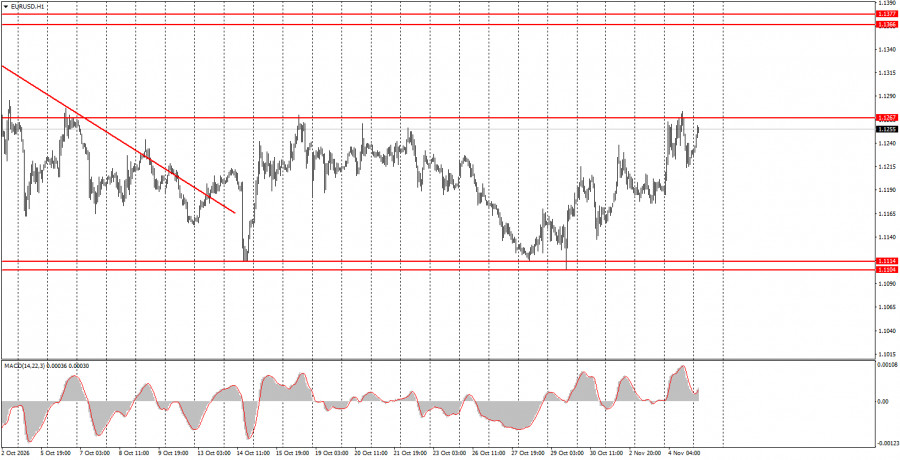
On Wednesday, the EUR/USD currency pair continued to move upward from the lower boundary of the sideways channel toward its upper boundary. The first point worth addressing at the end of the trading day is what has actually changed for the euro and the US dollar following the US Congressional elections. The European currency did strengthen slightly, but this movement took place within the sideways channel in which the pair has been trading for a month. Overall, the euro remains near the bottom of the market, trading at its lowest levels in a year and a half. However, it was previously noted that the Congressional elections alone would not be enough to trigger a new trend in either the euro or the US dollar. A change in the balance of political power does not automatically mean a change in political or economic policy. The dollar's future direction will depend on what the Democrats can do to counter Donald Trump's policies. For example, just yesterday, the Democrats stated that the war with Iran would end in the near future, while Donald Trump said that the war would end when he decided it should. Therefore, it is far from certain that the Democrats will be able to exert significant influence over Trump's policies.
EUR/USD 5-minute chart.
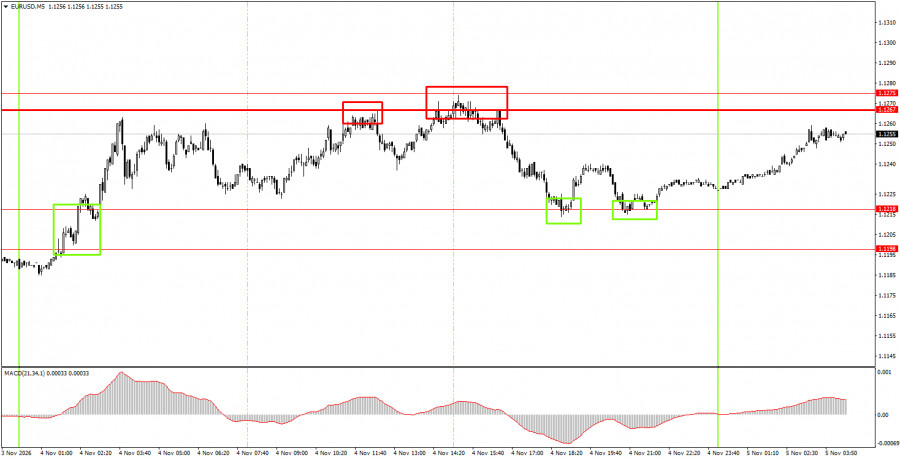
A considerable number of trading signals were generated on the 5-minute timeframe on Wednesday. However, even on this timeframe, it is clear that the price is moving sideways. The pair rebounded twice from the 1.1267–1.1275 level and twice from the 1.1198–1.1218 level during the previous trading day. Overall, daily volatility turned out to be relatively modest. All the signals provided opportunities to open profitable trades.
How to Trade on Thursday:
On the hourly timeframe, EUR/USD maintains its downward trend, which remains an established trend, while continuing to trade sideways between 1.1114 and 1.1267. The euro has failed to stage a meaningful correction in recent weeks, but the possibility of an upward trend remains. Taking into account all the events of recent months, there is no clear fundamental justification for such a sharp decline in the European currency. At present, the US dollar is significantly overbought, while numerous factors supporting the euro are being ignored by the market.
On Thursday, beginner traders may consider opening short positions if the pair rebounds from the 1.1267–1.1275 level, with a target of 1.1198–1.1218. Buy positions may be considered if the price closes above the 1.1267–1.1275 level, with a target of 1.1366–1.1377.
On the 5-minute timeframe, traders should monitor the following levels: 1.1011, 1.1104–1.1114, 1.1198–1.1218, 1.1267–1.1275, 1.1366–1.1377, 1.1461–1.1474, 1.1527–1.1531, 1.1584–1.1594, and 1.1655–1.1665. No major economic events are scheduled in the United States or the European Union on Thursday, apart from a speech by Christine Lagarde, which is of limited significance. It is worth noting that the market has largely ignored the ECB's monetary policy tightening.
Main Rules of the Trading System:
What the Charts Show:
Price support and resistance levels (zones) are levels that serve as targets for opening buy or sell positions or as sources of trading signals.
Red lines represent channels or trendlines that indicate the current market trend and show the preferred trading direction.
The MACD indicator (14, 22, 3), consisting of a histogram and a signal line, is an auxiliary indicator that can also be used to generate trading signals.
Important speeches and economic reports (listed in the economic calendar) can have a significant impact on currency pair movements. Therefore, traders should exercise extreme caution when such events are released or consider closing their positions to avoid sudden price reversals against the prevailing market direction.
Beginner forex traders should remember that not every trade can be profitable. Developing a clear trading strategy and applying sound money management are essential for long-term trading success.